Showing posts with label American history. Show all posts

Friday, March 13, 2009

If repealing Bush's puny marginal tax cuts makes Obama a socialist...

Then prepare yourselves to meet Presidents Ronald "Marx" Reagan, Richard "Trotsky" Nixon, and Dwight "Lenin" Eisenhower.


Anyone have any idea why I decided that wanted to be a lawyer?

I decided to be a lawyer because our world is full of people using language in nefarious ways, exploiting words like "socialist", "freedom", "diet", "healthy", "responsible", the list just goes on and on and on.....

I think that the law is a way for me to use precise language to advance something good, at the heart of the matter, where it counts.

Wednesday, November 19, 2008

Busy, busy

Can't write much as I have dedicated the rest of my life to poking around in Google's archive of historical photos from LIFE magazine. Click at your own risk.

Also, despite refusing to stay the current application of Prop 8, the CA Supreme Court has agreed to hear all three suits proposing to overturn it. Good news indeed.

Monday, November 10, 2008

Giddy-Making

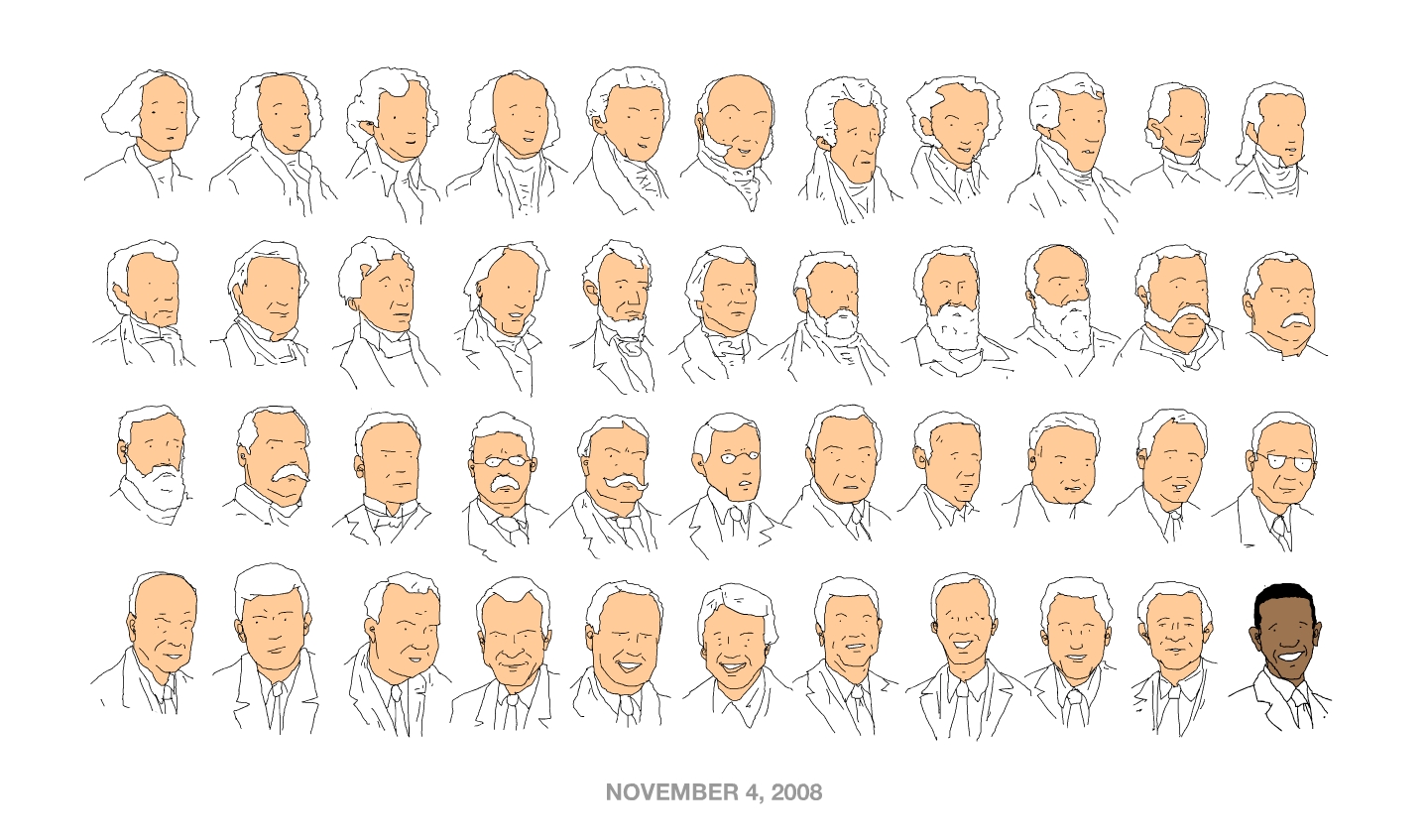
Professor Obama
Marcia DeSanctis | HuffPost

Barack Obama is now the face of the United States - the photograph we will see when we go through customs at JFK airport, or when we go to any U.S. Embassy on earth. The impact of this image, particularly at first, will be subtle, but immeasurable and its iconographic significance is multi-layered. He might refer to himself self-deprecatingly as a "mutt," but he is in effect, Globalized Man. With parts coming from all around the earth, passing through Asia on the way back to America, our new President now seems inevitable - this is the way the world is in 2008. But perhaps of even larger importance is that the leader of the world's greatest democracy was a professor of constitutional law and above all, a teacher. The Constitution - as in, the foundation of any functioning democracy - is his area of expertise. As such, he embodies the best possible advertisement for democracy at a time when the world needs it most and our country could benefit from, as Bill Clinton put it, the "power of example" rather than the "example of power."

Read the rest of the article here.

Friday, November 7, 2008

Thursday, November 6, 2008

The New America

A Black dude... more accurately, a multi-racial dude: the product of what some might refer to as "miscegenation".


An Irish Catholic.


A Jewish guy.


Suck on that, KKK!

Actual footage of the crowd I was in on election night!

I managed to find some clips of the crowd I stumbled into after wandering around on election night. What an experience... what unbridled joy.

This was my posse LOL... At this point the cops were moving us out of the Park and some kind of crazy conga line had broken out. The kids in the front were singing to the tune of "This Land Is Your Land", singing "Oh yes we can, oh yes we can... Barack Obama, Barack Obama"and the people in the back couldn't hear and were mostly just singing the regular song. LOL! This reminded me of a kind of strange inverse of when I was in high school choir and if you didn't know the words, you'd just sing "watermelon"!


Heh, this is us at the Christian Science Center Park, enthusiastically butchering the national anthem. Note the poor guy trying to conduct, and I also think you may catch a glimpse of the life-sized Obama cardboard cutout that was crowd-surfing!

Thanks to YouTube user michellezwi for posting these clips of what will no doubt be one of the most memorable events of my life.

Traditional Marriage Perverts the Tradition of Marriage

This was borrowed from a friend of a friend. A bit late, I suppose, and a bit long, but it neatly sums up exactly what it is that "traditional marriage" proponents are trying to protect.

Traditional Marriage Perverts the Tradition of Marriage
By Jeff Goode (Californian)

About a decade ago, as a young playwright, I was hired to write a script for the Renaissance Festival of Kansas City. It was a period piece about knights and jousts and intrigues of the court, building up to a lavish royal wedding between a prince and a princess, restoring peace to the troubled land.

This was one of my first professional writing assignments, so I was really excited about doing all the research and making sure that everything was historically accurate, especially the royal wedding which needed to follow all the traditions exactly.

Over a summer of research, I learned a lot of surprising facts about the history of marriage and weddings, but by far the most shocking discovery of all was that the tradition of marriage-as-we-know-it simply did not exist in those days. Almost everything we have come to associate with marriage and weddings - the white dress, the holy vows, the fancy cake and the birdseed - dates back a mere 50 or 100 years at the most. In many cases less.

And the handful of traditions that do go back farther than that are, frankly, horrifying. The tossing of the garter, for example, evolved from a 14th Century tradition of ripping the clothing off of the bride's body as she left the ceremony in order to "loosen her up" for the wedding night. Wedding guests fought over the choicest bits of undergarment, with the garter being the greatest prize.

Savvy brides got in the habit of carrying extra garters in their bodice to throw to the male guests in hopes of escaping the ceremony with some shred of modesty intact!

It turns out that marriage, in days of old, was a barbaric custom which was little more than a crude exchange of livestock at it's most civilized, and a little less than ritualized abduction at it's worst. That's why you'll find no reference to white weddings in the Bible, or the union of one man and one woman. Because up until fairly recently, there was nothing religious about it.

You will of course find plenty of biblical bigamy, practiced by even the most godly of heroes - Noah, Abraham, David, Solomon - because that's what marriage was in those days. Even in more enlightened New Testament times, the only wedding worth mentioning (the one at Cana) is notable only for the miraculous amount of wine consumed.

In the 21st Century, we've heard a lot about the sanctity of marriage, as if that were something that has been around forever, but in reality the phrase was invented in 2004. Google it for yourself and see if you can find a single reference to the "sanctity of marriage" before the Massachusetts Supreme Court legalized same-sex unions in that state. The proverbial Sanctity of Marriage sprang into being because opponents of gay marriage needed a logical reason to overturn an established legal precedent. And the only thing that trumps the Constitution is God himself.

Unfortunately, God is still pretty new to the whole marriage game (or he might have made an honest woman out of the Virgin Mary, am I right? Try the veal!)

The truth is that marriage has always been more a secular tradition rather than a religious one. Up until the early Renaissance, in fact, couples were traditionally married on the church's front doorstep, because wedding ceremonies were considered too vulgar to be performed inside the building: After all, there was implied sex in the vows and shameless public displays of affection. No clergyman in his right mind would have allowed such an unholy abomination on the premises.

But as times changed, ideas and attitudes about marriage also changed. So when people became religious, matrimony became holy. When people became nudists, clothing became optional. And so on throughout history.

And the wonderful thing about the institution of marriage - the reason it has remained strong and relevant through thousands of years of ever-changing times - is its unique ability to change with those times.

Marriage is, and always has been, a constantly evolving tradition that never fails to incorporate the latest shifts in culture and climate, changing social habits, fashions and even fads. (Because, seriously, that chicken dance is not in the Bible.)

Thus, in the 1800s when the sole purpose of marriage was procreation and housekeeping, marriage between an older man and a hard-working tween girl was considered perfectly normal. Today we call it pedophilia.

For thousands of years marriage was essentially a business transaction
between the parents of the bride and groom. But in the last century or so, we've finally seen the triumph of this new-fangled notion that marriage should be about a loving relationship between two consenting adults.

Followers of the Mormon faith can tell you that the traditions of their forefathers included a devout belief that polygamy was appropriate and sanctified. But modern Mormons generally don't support that vision of happiness for their daughters.

And during the Civil Rights era, when opponents of interracial marriage tried to pass laws making such couples illegal, we came to realize that they, too, were wrong in trying to redefine marriage to prevent those new-found relationships.

Always marriage has triumphed by becoming a timely celebration of our society, rather than a backlash against it. It's strange, then, to see "tradition" used as a weapon against change, when change is the source of all its greatest traditions.

Just ask the white dress:
In 1840, Queen Victoria of England married Prince Albert wearing a beautiful white lace dress - in defiance of tradition - in order to promote the sale of English lace! The image was so powerful that practically overnight the white wedding gown became de rigueur for the well-heeled bride. And then it became de rigueur for every bride.

By the dawn of the 20th Century, the white dress had also inexplicably come to symbolize chastity. (Even though blue was traditionally the color of virginity - "something borrowed, something blue...")

And the new equation of white with virginity eventually achieved such a rigid orthodoxy that older readers may remember a time when wedding guests who happened to know that the bride was not perfectly pure would have felt a moral obligation to demand that she change into something off-white before walking down the aisle.

Fortunately, as cultural norms eased during the Sexual Revolution, a sort of "don't ask, don't tell" policy took hold where all brides were required to wear white regardless of their virtue and the less said about it the better.

In recent years, as a generation of divorcees have remarried and a generation of young people have entered wedlock with some degree of "experience", the pretense of a connection between literal virginity and the bridal gown has become entirely obsolete. A colorful journey for a custom which has always seemed iron clad, even as it was evolving over time.

And not all traditions have to do with changing sexual standards. The long-time custom of pelting the newlyweds with birdseed did not exist before the 1970s when animal-lovers realized that songbirds were bloating on dried rice that they found on the ground after the former custom.

Economic times have caused families to rethink the age-old convention of the bride's father paying for the entire ceremony - a last vestige of the days of dowries when a young man had to be bribed to take a free-loading daughter off her parents' hands - that well-established custom has gradually given way to a more humane approach to sharing the financial burden.

Even religious traditions of marriage have experienced constant metamorphosis over the years. As more interfaith couples have wed, we have seen the emergence of multi-disciplinary ceremonies where couples have chosen not to follow the out-dated tradition of rejecting one or both of their faiths as a prerequisite of holy matrimony.

One of the most beautiful weddings I ever attended was between a young Jewish fellow and his Catholic fiancé, whose mother was born in France. The ceremony was performed by both a rabbi and a priest with intertwining vows in English, Latin, Hebrew and French. A perfect expression of the union of their two families, yet one which would have been unthinkable just a generation before.

But, again, marriage has such a long history of changing with the ever-changing times, that the last thing we should expect from it is to stop growing and changing. We know today that marriage is not a rote ritual handed down by God to Adam & Eve and preserved verbatim for thousands of years. It is, rather, an expression of how each community, each culture, and each faith, chooses to celebrate the joining of loved ones who have decided to make a life together.

Christians do not expect Jesus to be central to a Buddhist wedding, nor do Jews refuse to acknowledge Lutheran unions because they didn't include a reading from the Torah. Marriage is what we each make of it. And that's the way it always should be.

Perhaps the greatest irony of the traditional marriage argument is that it seeks to preserve a singular tradition that has, in fact, never existed at any point in history.

Because, honestly, which traditional definition of marriage do we want our Constitution to protect?

... The one from Book of Genesis when family values meant multiple wives and concubines?
... Or the marriages of the Middle Ages when women were traded like cattle and weddings were too bawdy for church?
... Since this is America, should we preserve marriage as it existed in 1776 when arranged marriages were still commonplace?
... Or the traditions of 1850 when California became a state and marriage was customarily between one man and one woman-or-girl of age 11 and up?
... Or are we really seeking to protect a more modern vision of traditional marriage, say from the 1950s when it was illegal for whites to wed blacks or hispanics?
... Or the traditional marriage of the late 1960s when couples were routinely excommunicated for marrying outside their faith?

No, the truth of the matter is, that we're trying to preserve traditional marriage the way it "was and always has been" during a very narrow period in the late 70s / early 80s - just before most of us found out that gays even existed: Between one man and one woman of legal age and willing consent. Regardless of race or religion (within reason). ...Plus the chicken dance and the birdseed. Those are okay.

But there's something profoundly disturbing about amending the Constitution to define anything about the 1970s as "the way God intended it".

Tuesday, November 4, 2008

I am one giant goosebump

I'm sitting in a bar in Jamaica Plain, Massachusetts, and history has just come f'in crashing down all around me, around all of us. I'm in the street and there are strangers running by hugging me and crying. Today's the first day of the rest of it. Yes we did!
Sent wirelessly via BlackBerry from T-Mobile.

Friday, October 24, 2008

Notes on my Friday... regarding CA Prop 8 and AZ Prop 102

This all started because a friend of mine wrote that an organization in which her dad's involved was a big supporter of CA Prop 8, aiming to constitutionally ban gay marriage and take away the marriages that have already been performed there. It's an interesting series of points about how fairly minute differences in state civics can make huge differences in how rights are protected in different states... in particular, the differences between states with "direct-democratic" principles like initiative, referendum, and recall, and states that adhere to the original representative frameworks. I've put it in temporal order for legibility's sake.

----------------- Original Message -----------------
From: Erika
Date: Oct 24, 2008 1:00 PM


Well, yeah, KofC is a Catholic organization. So... most of the big opponents are affiliated with religion in some way. Nothing helps a community like keeping non-traditional families weak, you know! It's gross. I spent a whole day the other day looking at all the people and organizations who've donated directly. You can look at it here:
http://www. latimes. com/news/local/la-moneymap,0,2198220. htmlstory
The good news is that in the last few weeks we've pulled even with them money-wise. The bad news is that a higher percentage of our support comes from outside CA, though that may not necessarily translate to fewer votes, it may be just weaker organization within CA. I fear that come election day I'll have a mixed bag and be so happy about President Obama and be so sad about this. It could still get shot down though... I really hope it does.

----------------- Original Message -----------------
From: (my friend)
Date: Oct 24, 2008 5:40 PM


i guess i don't totally understand prop 8. i mean, isn't gay marriage legal in ca now? are they trying to reverse that? it's just crazy. i keep thinking about the non-traditional thing too... i want to propose a ban on gay marriage and add "and inter-racial "marriage," because the bible preaches slavery" to the bottom of it... then we can see how many people check their "values"

but anyway - it's good to see that the contributions are neck and neck even though there's all those corporate supporters. easy answer: stop recognizing marriage as a legal bond and they can keep marriage. i would rather have it legal though.

----------------- Original Message -----------------
From: Erika
Date: Oct 24, 2008 6:38 PM

Yeah, with Prop 8 the CA courts ruled the gay marriage ban in the CA civil codes unconstitutional... that ban was placed in the civil code by popular vote in 2000. So the tactic of Prop 8 is to constitutionalize the ban, therefore overruling the court's decision and the basis upon which it rests. It's a very tricky legal tactic and honestly, I believe it won't stand for long even if it does pass this year. My primary concern is for those people who have already been married and are on the verge of having their rights taken away again. Frankly, it's cruel. The courts know that you can never win minority rights by popular vote, especially when the majority has so successfully been convinced that they will somehow lose something if their rights are shared by "undeserving" minorities. It's a basic danger of democracy that was addressed by the Framers hundreds of years ago. But most Western states and a few others east of the Mississippi instituted direct democracy laws within the last hundred years. These can place the will of the majority equal to, and in some cases above, the legislature and the courts. Originally the constitutions of states could never be changed by popular vote, only by the legislators... the Founders thought it was crazy and dangerous to put the rights of the whole in the hands of the majority and always moved against it. So that's your civics lesson for today lol. Any other confusions? I believe that Prop 8 may squeak by and it may not. Some people who don't necessarily support gay marriage agree on principle that it's heartless to take away what rights someone has already won. Prop 102 in AZ, I will be very surprised if that does not pass. Direct Democracy at work.

Sunday, October 5, 2008

Revisiting our textbooks

Why are so many Americans clueless about American history and civics?

Casual efforts to administer to regular citizens the exact same exam questions that a naturalized citizen must take yield dismal results. Lots and lots of people, even people who vote in every election, don't realize that the President is not elected by popular vote. Most of these people can not name who would ascend to the Presidency if both the Pres and VP died, and some of those who can name the position are unsure who currently fills it. From all I can tell, a majority of Americans do not know how many Justices make up the Supreme Court.

These are just the civic issues... the historical issues may be even worse. Do you know who was President during World War I? The naturalized citizen up the street, who gave up their life in another place because they believed in the promise of America, does. Ask an American to list the Presidents in order and many will fall off after #1. Most will quit or be dead wrong after 2, 3, or 4. Better yet, ask them to give the Presidents in reverse order, starting with George W. Bush. An occasional American does not know the name of the current President, and many do not know the name of the current VP. Again, the further along you get, the quicker they start dropping. Here's a fun one: who did America fight in the war for our independence? IF you'd answered France, you'd be so very wrong, or funny, but you'd also be very far from alone.

Why is it we as Americans do not feel compelled to understand these basic things about our own country? When we say that America is the greatest nation on earth, is it just because we were lucky enough to be born here, or do we stand for something more, for our own common ideals? To claim the exceptionalism of America without understanding what makes our country great is bald nationalism, which has a long history of turning great countries to piles of rubble. Let's not do that, hmmm?

Monday, November 28, 2005

My translation of the last post LOL - originally from MySpace

I have to write like that for school. It translates to mean this:

The major problem with democracies is that everybody's out for themselves and so the choices that are really in everyone's best interests are often overlooked, and that's how majority rule can devolve into mob rule. People often blame the government for the disillusionment of its citizens, but more often than not, it's the warring parties that are to blame. Since we can't get everyone to agree on everything, the best way to combat this problem is by limitations of power. This is one of the benefits of having a republic (representative democracy) instead of a true democracy where we all represent ourselves; through the process of debate the virtue of minority decisions can be brought to light, at least enough to keep the majority from shitting all over everyone else. Most importantly, having a big nation of diverse people keeps the majority small in the periods of time where a majority exists at all. Despite our 2-party system, there are fewer true majority issues than you might think.

Mebbe I should just post that instead. :)

Click here to read my summary of the 10th Federalist Paper

Madison asserts that the central problem posed by factious interests is that, in the clash of opponent factions, the public good may be overlooked; thus policy may be set according to mob rule as opposed to the interests of justice and protecting the rights of all citizens. He also posits that it is the influence of faction, not raw governmental form, which further leads to doubt of those in the public sphere and concern over the state of civil rights. Madison then contends that, since the interests of varying groups cannot be practically unified, the effects of faction must be controlled for; this, he proposes, must be done by limiting the ability of majority factions to dominate others and railroad government into preserving their own interests. The republican scheme, wherein a large number of citizens elect a small number to represent them in the halls of governance, is recommended as an effective means of control. In this case, variant public perspectives may be distilled into a cohesive agenda that bears the public good as its highest interest; this relates to the concept of agenda-setting as a means of determining policy choices. Additionally, Madison suggests that the breadth and diversity of the citizenry are much to its benefit in avoiding factious violence, as a greater variety of interests might preclude the possibility of an imperious majority, yielding instead a plurality that cultivates public benefit.